
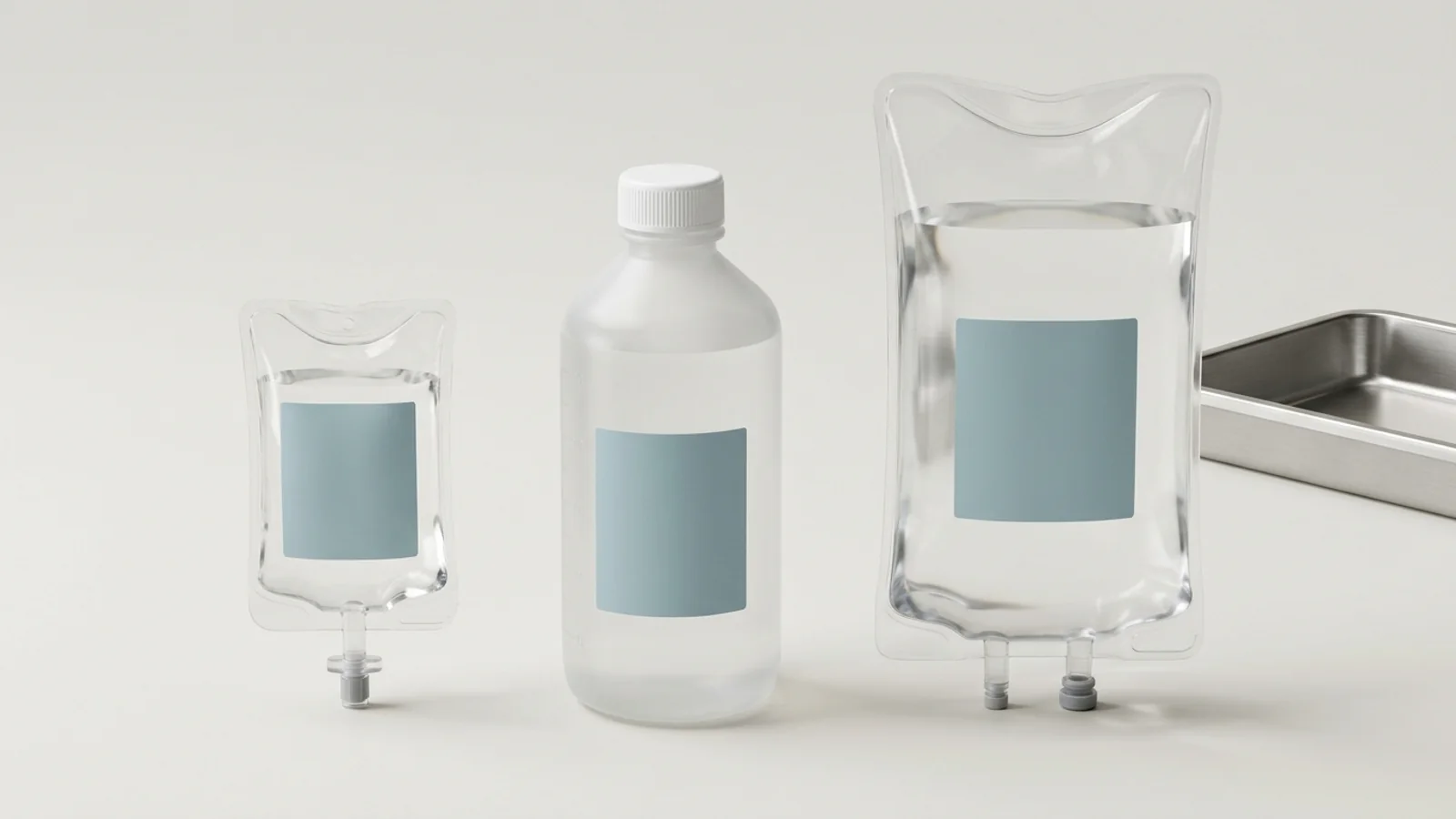
Two products called 0.9% sodium chloride
A purchase order that says only “0.9% sodium chloride” leaves an important question unanswered: is it ordering irrigation or injection stock? B. Braun’s irrigation insert describes the solution as “identical in composition” to normal saline injection, yet also states “For Irrigation Only. Not for Injection.” Baxter’s cited injection labeling identifies intravenous administration. Equal concentration does not authorize receiving teams to swap these products. See the March 2026 B. Braun insert and Baxter injection label.
Before shelving a delivery, match the route, concentration, container, warning text, identifier and lot/expiry record to the approved order. If the order itself is ambiguous, obtain clarification from the responsible buyer or pharmacy team before assigning a stock location. The checks below are a purchasing and receiving workflow derived from product labeling and safety reports. They do not select a fluid for a patient or authorize a change in clinical use.
Read the labeled route first
FDA’s Drugs@FDA record for NDA 016733 lists B. Braun’s 0.9% product as SOLUTION;IRRIGATION, with prescription status. The record identifies it as the reference listed drug and reference standard. This provides application-level evidence for the irrigation product; it is not a basis for treating an injection item as an interchangeable delivery. Keep the exact application, product and route together when reviewing a proposed supplier change.
| Cited product | Labeled route | Concentration and electrolyte content | Calculated osmolarity |
|---|---|---|---|
| Baxter 0.45% sodium chloride injection | Intravenous | 4.5 g/L; sodium 77 and chloride 77 mEq/L | 154 mOsmol/L; hypotonic |
| Baxter 0.9% sodium chloride injection | Intravenous | 9 g/L; sodium 154 and chloride 154 mEq/L | 308 mOsmol/L |
| B. Braun 0.9% irrigation, March 2026 PIC insert | Irrigation; injection excluded | 0.9 g/100 mL; sodium 154 and chloride 154 mEq/L | 310 mOsmol/L |
These values are transcribed from the two labels linked above. The B. Braun PIC insert lists 310 mOsmol/L; its separately cited flexible-container record and several other irrigation labels list 308. Record the value in the exact product’s labeling rather than imposing a universal 308 requirement. Neither number determines route, and this comparison does not establish a clinical difference between the products.
Match the container and indication to the order
Separate the presentation from the fluid name. The records below demonstrate why a volume-only order is incomplete. They document labeled formats, not a live availability list or cross-manufacturer compatibility assessment. The older Baxter records remain useful examples, but buyers should obtain the current supplied label and catalog confirmation before placing an order.
| Label record | Documented presentation | Identifier example | Receiving distinction |
|---|---|---|---|
| B. Braun PIC, revised March 2026 | 500 and 1000 mL containers; 16 per case | 0264-2201-10 / 0264-2201-00 | Different presentation from the large flexible containers below |
| B. Braun flexible irrigation, older DailyMed record | 2000 and 3000 mL; 4 per case | 0264-7388-50 / 0264-7388-60 | Use the flexible-container record for these sizes |
| ICU Medical flexible irrigation, record updated October 2025 | 3000 mL single-dose bag | 0990-7972-08; legacy 0409-7972-08 | Confirm the labeler-code mapping before receipt |
| Baxter pour-bottle record, displayed update February 2014 | 250, 500 and 1000 mL bottles | 0338-0048-02 / -03 / -04 | Evidence of pour-bottle formats; confirm current supply |
| Baxter ARTHROMATIC, displayed update July 2018 | 3000 and 5000 mL containers | 0338-0047-27 / -29 | Arthroscopic indication; confirm current supply |
| Baxter 0.9% injection, displayed update July 2024 | VIAFLEX bags with listed sizes from 25 to 1000 mL | 0338-0049-03: 500 mL; -04: 1000 mL | Injection stock has its own labeled route and codes |
Presentation sources: B. Braun PIC, B. Braun flexible containers, ICU Medical flexible irrigation, Baxter pour bottles, Baxter ARTHROMATIC and Baxter injection. Identifiers abbreviated after a slash in this table retain the preceding labeler and product segments; use the full code on the supplied unit for actual receipt.
The cited flexible-irrigation record identifies ICU Medical as packager and retains the legacy 0409 code. It documents a transition from the 0409 to the 0990 labeler code, with both expected in the market for a period. Treat an unfamiliar code as a mapping question requiring documented confirmation, rather than automatically accepting or rejecting it by appearance.
Material claims also attach to a particular presentation. The ICU Medical record describes PVC and its panel identifies DEHP; B. Braun’s cited PIC and flexible-container labels state that they are not made with PVC or DEHP. Record the relevant disclosure if it is part of the purchasing specification. This comparison does not rank the materials or establish suitability for a patient group.
Indication scope needs a separate check. Baxter’s ARTHROMATIC labeling is for arthroscopic irrigation with endoscopic instruments; the cited general-irrigation records have broader wording. Do not copy one product’s indication into another item-master entry. Ask the responsible clinical or pharmacy reviewer to resolve a mismatch before approving a replacement.
Keep product identity separate from the code format
The drug-label examples above carry National Drug Codes (NDCs). FDA’s Nurse Assist safety communication also describes recalled saline and sterile-water medical devices and supplies product identifiers, including UDIs. Its tables include some entries without a UDI and some marked as customer-kitted. A rule that every saline delivery must have one particular code type would miss this variation.
Record the manufacturer, exact labeled product, catalog code and available regulatory identifier together. An NDC or UDI is a matching field, not permission to infer route from the barcode. The Nurse Assist notice includes products described as IV-flush syringes, so its device list must not be read as a list of irrigation-only items. Check each unit’s intended use. The site’s UDI receiving guide explains identifier capture in more detail.
Use six fields at goods receipt
Use this checklist to turn the cited evidence into a local acceptance record. Agree the inspection scope and responsible reviewers before delivery. These are recommended purchasing controls, not a claim that a regulator mandates this exact six-field form or inspection of every unit in every shipment.
| Field | Record from supplied labeling | Match against | Hold for review when |
|---|---|---|---|
| 1. Route and indication | Route statement and intended-use wording | Approved order and item-master purpose | Route differs or indication scope is unresolved |
| 2. Concentration | Full solution name and percentage; product-specific osmolarity where recorded | Exact ordered formulation and current label | Concentration differs or a numerical discrepancy needs explanation |
| 3. Container and closure | Format, nominal volume, closure/overwrap condition and case quantity | Ordered presentation and documented packaging requirements | Format differs, leakage is visible, or integrity is suspect |
| 4. Warning text | Legible route restrictions on the relevant label | Manufacturer’s supplied labeling | Warnings are obscured, missing or contradictory |
| 5. Product identity | Manufacturer, catalog code and applicable NDC or UDI | Verified supplier and item-master mapping | Code or manufacturer changes lack confirmation |
| 6. Lot, expiry and recall scope | Lot, expiry, relevant notice and kit identity when applicable | Contract shelf-life terms and applicable recall instructions | Stock is expired, recalled or cannot yet be reconciled |
For example, suppose the order calls for a 1000 mL injection bag and the delivery is a 1000 mL irrigation container. The volume and concentration may match, but the route field fails. Record the observed label and order reference, keep the affected stock out of available inventory, and ask the responsible team to resolve the discrepancy. A supplier’s verbal statement that it is “the same saline” does not close the route mismatch.
A second example is an order for a pour bottle fulfilled with a flexible irrigation bag. Both may be irrigation products, yet the requested presentation has changed. Document the difference and obtain review of the replacement before release. Do not convert a container-format question into an informal claim of connector compatibility. The IV administration-set guide addresses set specifications as a separate purchasing decision.
Keep the evidence useful to the next reviewer: order line, observed product code, lot, expiry, quantity affected, label photograph, discrepancy and disposition owner. Distinguish outer-carton damage from suspected container or closure damage. Record what was seen without claiming that visual inspection proves sterility; the goods-receipt damage guide develops that documentation approach.
Buy and store with wrong-route errors in mind
The 2020 AHRQ PSNet cases involved two 1000 mL saline-based bladder-irrigation mixtures containing gentamicin. They were found connected to IV tubing before infusion. The commentary describes inconspicuous labeling, shared storage and shared poles as contributing risks. These were near misses involving prepared mixtures, not evidence of a defect in a particular manufacturer’s plain irrigation product.
ISMP Canada’s 2016 bulletin describes two unintended IV infusions of heparinized lactated Ringer’s irrigation. The 2019 P&T commentary discusses those same cases; it is not an additional independent pair. Case reports establish that the error can occur but do not supply an incidence rate. They also undermine any assumption that packaging always physically prevents a wrong-route connection.
ISMP Canada recommends route-specific packaging, distinct bag sizes as a cue, prominent irrigation warnings, segregated storage and designated irrigation equipment. Buyers can discuss these controls with pharmacy, materials management and the relevant users:
Specify the required presentation in the purchase order, then assess whether alternatives preserve the intended local workflow.
Use size and appearance as supplementary cues. Read the label even when the container looks familiar.
Agree how irrigation and injection stock will be separated and identified in storage, including warming areas where applicable.
Check that auxiliary labels preserve the manufacturer’s identity, route warnings, lot and expiry. Confirm local labeling responsibilities before introducing them.
The evidence supports a coordinated storage and purchasing review. It does not justify a universal ban on every 1000 mL irrigation container or a claim that all pour bottles are impossible to connect to administration equipment. Product-specific labeling remains necessary.
Check recalls inside kits as well as bulk stock
The November 2023 Nurse Assist company recall announcement hosted by FDA concerned potential lack of sterility assurance in specified saline and sterile-water products, including bottles, sprays, cups and syringes. It reports distribution from November 1, 2021 through September 18, 2023. This was a defined recall, not evidence that all irrigation saline was affected or that every recalled unit was contaminated.
Most listed expirations ran through September 18, 2025. The exception extending through September 18, 2028 was part 1030A, a sterile-water syringe. As of October 2026, the 2025 dates are already past; the 2028 exception concerns sterile water, rather than saline. The enduring receiving lesson is that an unexpired date alone cannot clear a recalled product.
FDA’s April 15, 2024 safety update links related actions involving kits, trays and other packaged systems from firms including Cardinal Health, Busse, ROi CPS, Windstone/Aligned, Maquet, Avanos and Medline. Scope varies: for example, the Avanos entry concerns sterile-water syringes in feeding-tube kits. Do not describe every related action as recalled saline in surgical trays.
For a relevant notice, identify the exact brand, product code, lot and other scope criteria, then check the assembler’s affected kit codes and lots. Preserve the supplier’s component-to-kit mapping when it is needed to reconcile inventory. Do not open a sterile kit merely to identify a component; seek the assembler’s records and follow the recall instructions. Unresolved scope should remain with the designated recall or quality owner.
Apply the same reconciliation to stock already on shelves, not just today’s delivery. Keep the notice date and the evidence used for the decision so another reviewer can reproduce it. The mixed-lot recall guide covers the broader inventory exercise.
Evidence limits and supplier changes
This comparison uses US product labeling, FDA records and safety reports checked on October 28, 2026. Displayed label-update dates can differ from archive publication dates. The 2014 pour-bottle and 2018 ARTHROMATIC records are used for documented format and indication examples, without claiming present availability. No laboratory, connector, sterility or clinical-equivalence testing was performed.
Recheck the exact supplied label when a manufacturer, code, concentration, container, indication or packaging configuration changes. Assign responsibility for updating both the item master and receiving instructions. A complete specification lets a reviewer distinguish an explained code transition from a change in the product actually being purchased.