
Start with the function on the exact SKU
Before accepting a replacement heat and moisture exchanger (HME) or heat and moisture exchanging filter (HMEF), compare the exact order code with its applicable local labeling. Keep the stated patient population and tidal-volume range beside the manufacturer’s volume term, resistance at specified flows and test states, and moisture and filtration evidence. Matching connectors or a high filtration percentage alone cannot establish an acceptable substitute. Missing fields require clarification; clinical suitability belongs to the responsible clinical team.
The function distinction comes first. Intersurgical’s HME and HMEF explainer describes an HME as conserving expired heat and moisture. Its HME range is not claimed to provide bacterial or viral protection. An HMEF combines an exchanger with filtration. Check the claim for the exact product rather than extending a family description to every housing that looks similar.
A filter-only product is a separate comparison category. Medtronic’s electrostatic-filter catalog supplies filtration specifications without a moisture-performance value. That absence is not a measured zero and does not authorize borrowing a humidification result from an HMEF row.
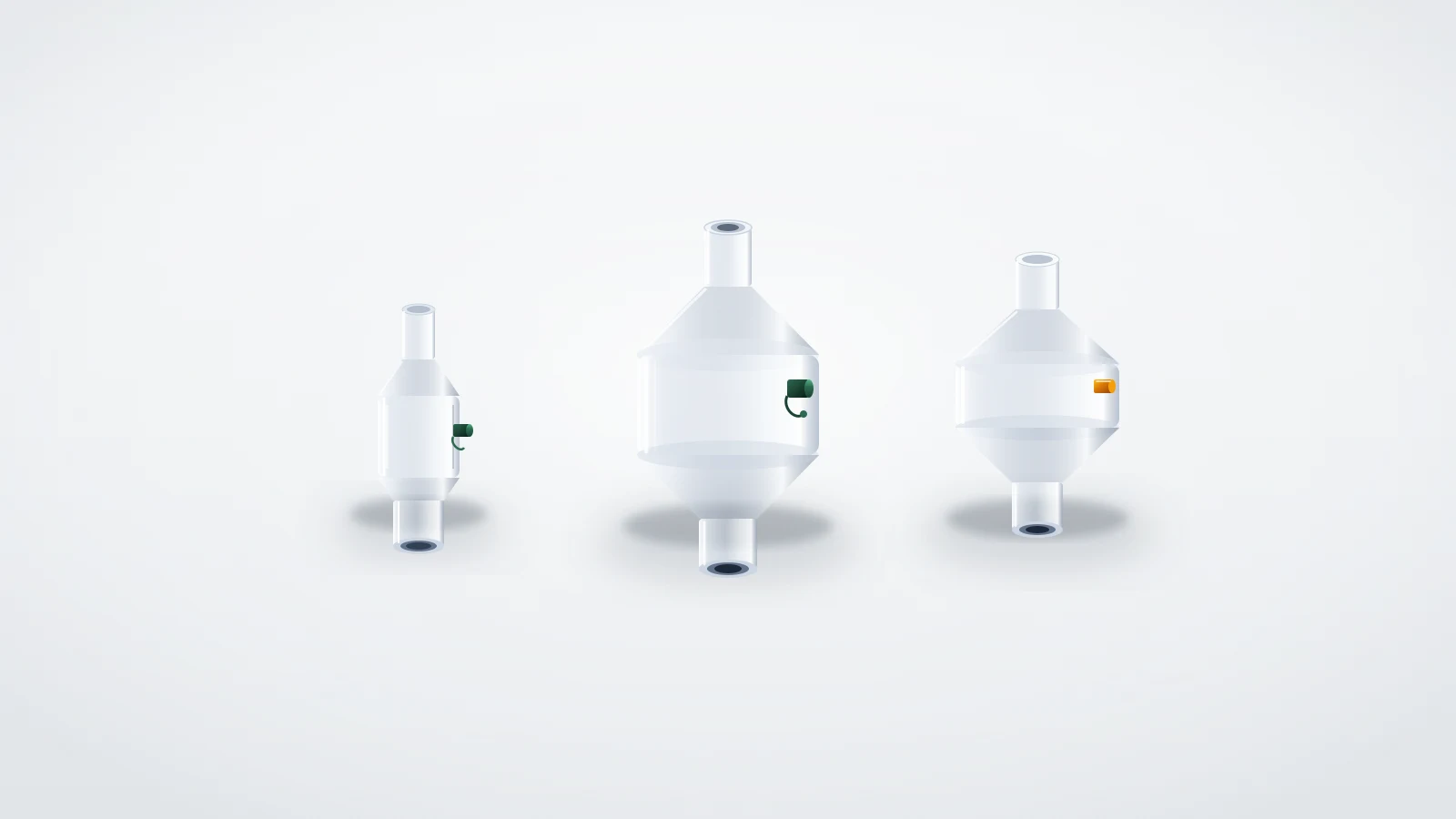
The examples below are manufacturer-reported catalog observations checked on 11 November 2026, with an older sheet identified separately. They are not independent tests, a ranking, a current supplied-lot assessment or evidence of market availability. Obtain the applicable local IFU and packaging for the proposed REF and configuration before making a purchasing decision. The hero illustration shows generic housings, not the named products.
Keep population, volume and resistance in one record
Use one record per REF and supplied configuration. A family name is useful for navigation, but a purchasing record should also identify the market, document title, revision or publication date, access date and exact table column. Otherwise a future reader cannot tell whether two values describe the same item. Keep the original wording alongside any normalized item-master field so that the normalization remains auditable.
Treat volume terminology as a question to resolve. If a supplier calls a value internal volume, dead space or compressible volume, copy that term and its unit. Do not replace it with another term or assume the terms measure the same thing. Request the definition and component boundary: does the figure cover only the housing, or also an elbow, mount, adapter or sampling component supplied with it? If the document does not answer, record “not stated.”
Attach the flow rate and pressure unit to every resistance figure. Keep a source’s “before use” and “after use” results separate, including the stated conditioning duration. Do not infer an after-use value from a before-use result, interpolate an unreported flow point or compare two pressure figures after discarding their conditions. A smaller number at a different flow is not a defensible basis for selecting a substitute.
The practical output is an evidence gap, not a calculated bedside correction. For example, two records can have the same population name but different volume terms or unaligned flow points. Mark the comparison incomplete, state which field needs clarification and name its reviewer. This makes the uncertainty visible without inventing a pass/fail limit. Related endotracheal-tube specifications and tracheostomy inner-cannula matching remain separate identity checks; this worksheet does not establish those connections.
Read the example SKU records without inferring equivalence
The following editor-assembled record joins four examples by REF. Each link points to the source’s Specifications and Ordering information sections. The smallest HMEF’s REF-to-family mapping also uses page 2 of the December 2021 US information sheet; its Infant-Pediatric wording differs from the catalog’s Pediatric-neonatal/Hygrobaby column. That mapping needs local-label confirmation.
| Manufacturer / REF / function | Source population and Vt | Source volume term | Before-use resistance | Moisture evidence |
|---|---|---|---|---|
| Medtronic DAR Hygrolife II / 353U5413; HME | Adult-pediatric small; 100–1000 mL | Internal volume: 29 mL | 1.0 cm H2O at 30 L/min; 2.3 at 60 L/min | Loss: 8 mg H2O/L at Vt 500 mL |
| Medtronic DAR Hygrobac S / 352U5877; HMEF | Adult-pediatric small; 150–1200 mL | Internal volume: 51 mL | 1.2 cm H2O at 30 L/min; 2.7 at 60 L/min | Loss: 6 mg H2O/L at Vt 500 mL |
| Medtronic DAR / 355U5427; HMEF; mapping caveat above | Catalog: Pediatric-neonatal small; 30–100 mL | Internal volume: 10 mL | 0.6 cm H2O at 5 L/min; 2.5 at 15 L/min | Loss: not stated in catalog |
| Medtronic DAR Barrierbac S / 350U5879; filter-only | Small; adult/pediatric family; 150–1200 mL | Internal volume: 39 mL | 0.8 cm H2O at 30 L/min; 2.0 at 60 L/min | Not stated in catalog |
| Proposed supplier / REF: _____ | Exact local population wording / Vt: _____ | Original term, value, unit / components: _____ | Value, pressure unit, flow / state: _____ | Metric, value, unit / conditions: _____ |
Keep these additional fields attached to the same REF. P and M below mean patient and machine ends as reported in the ordering tables; retain the connector notation without treating it as a compatibility determination. “Not stated” identifies an evidence gap in the cited record, not a failed test.
| REF | Catalog filtration results, kept separate | Catalog end connections | Ports and use-limit evidence |
|---|---|---|---|
| 353U5413 | Not stated | P: 22M/15F; M: 22F/15M | Catalog indicates single use; exact port configuration and duration require local confirmation |
| 352U5877 | NaCl: 96.5%; bacterial: ≥99.9998%; viral: >99.999% | P: 22M/15F; M: 22F/15M | Family page: single-patient use, replacement at least every 24 h; confirm exact port and applicable local label |
| 355U5427 | Smallest catalog column: NaCl 93.5%; bacterial ≥99.999%; viral ≥99.99%; REF mapping caveat applies | P: 15F; M: 15M | Family use statement as above; exact configuration and label confirmation pending |
| 350U5879 | NaCl: 98.2%; bacterial: ≥99.9999%; viral: ≥99.999% | P: 22M/15F; M: 22F/15M | Family page: single-patient use, replacement at least every 24 h; confirm exact port and applicable local label |
For every populated row, the precise supplied-component volume boundary, SKU-specific port configuration, current local IFU revision, clarification date and local review disposition remain unverified. No supplier response or local suitability decision was obtained. Carry those open fields forward rather than interpreting a filled numerical table as product approval. The linked catalog pages do not establish complete moisture-test conditions for these excerpts.
Read across a single row before comparing down a column. The filter-only row does not become an HMEF because some of its numbers appear favorable. The smallest HMEF row cannot be ranked against adult-flow entries using unaligned test points. These are limits on the comparison method, not conclusions about which device should be used for a patient. Keep a candidate unresolved until the evidence needed for its intended review is available.
Separate moisture evidence from filtration evidence
Keep moisture loss and moisture output or return in separate fields. Ask for the method, test volume, duration and other stated conditions rather than changing the metric name to make a table look uniform. Likewise, keep salt, bacterial and viral challenges separate. The catalog results above do not establish a universal filtration percentage or measure infection incidence. No particle-size protocol or biological challenge organism is inferred here.
The public ISO catalog entries provide a map of scope and status. They do not supply the full paid requirements or demonstrate that an example meets them:
| Reference and public source | What the catalog establishes | Purchasing boundary |
|---|---|---|
| ISO 9360-1:2000 | HME standard titled for minimum tidal volumes of 250 mL; published and marked for revision | A citation alone establishes neither neonatal suitability nor product nonconformity |
| ISO 23328-1:2003 | Short-term airborne sodium-chloride challenge for breathing-system filtration | Keep the challenge and result separate from biological tests |
| ISO 23328-2:2002 | Non-filtration scope: ports, leakage, flow resistance, packaging, marking and supplied information | Scope does not verify a particular connector, clinical fit or humidification claim |
| ISO/DIS 9360-1 | Draft common requirements; under development, in enquiry when checked | Do not treat it as a published replacement or proof of regulatory adoption |
Ask which edition and report support each supplier claim. A report identifier, date and applicable configuration make a claim reviewable; a bare standards number does not. This is an evidence request, not a claim that every field has a universal acceptance threshold. Any legal adoption or regulatory-recognition question requires its own applicable evidence, beyond these public catalog entries.
Resolve source differences before changing the order
Keep both observations when documents disagree. For REF 352U5877, the December 2021 sheet, page 2 reports before-use resistance of 2.8 cm H2O at 60 L/min; the US catalog’s Hygrobac S column reports 2.7. Neither the cause nor the value controlling a supplied lot was established. Do not average the entries or infer a redesign.
| REF / field | Source difference | Supplier question and present disposition |
|---|---|---|
| 352U5877 / before-use resistance at 60 L/min | 2021 sheet versus accessed US catalog; values above | Which specification and local IFU apply to the quoted configuration and lot? Response/date: not obtained; review: pending |
| 355U5427 / family identity | 2021 sheet: Infant-Pediatric; smallest catalog column: Pediatric-neonatal / Hygrobaby | Confirm the precise REF, population wording, ports and applicable local labeling. Response/date: not obtained; review: pending |
| 352U5877 and 355U5427 / salt-filtration entries | The 2021 sheet and accessed catalog also show different NaCl results | Identify applicable methods, reports and specifications; retain documents separately. Response/date: not obtained; review: pending |
The discrepancy register should preserve both document versions and a locator for each observation. Ask the supplier to identify the controlling specification and explain whether the records describe different methods, configurations or revisions. Those are questions, not established explanations. Retain the response with its date and reviewer; if applicability remains unclear, leave the item-master comparison open rather than silently choosing the more convenient source.
Request local labeling and missing specification fields
Use the applicable local label to resolve product-specific questions. An overseas or older document can reveal what to ask, but its jurisdiction, revision and exact product coverage still need checking. Do not assume either local applicability or regulatory clearance from the fact that a manufacturer hosts it.
A bounded example is the English/Thai regional filter-HME IFU, Part No. 10050775 Rev C, September 2021. Its English page 3 specifies single use and a maximum 24-hour use limit, excludes use with heated humidifiers or nebulizers, and warns against use below its tabulated tidal-volume indications. It also identifies obstruction concerns and individualized clinical assessment of added dead space. These are fields to verify in the proposed product’s local labeling, not a universal schedule or setup instruction. This regional document was not verified as current US supplied-product labeling.
The blank intake record below complements the example rows. It is an editor-proposed purchasing worksheet, not an agency checklist or a conformity certificate. Fill it for each proposed configuration and distinguish a supplier statement from a document you have actually reviewed.
| Record field | Blank supplier / local review entry | Evidence to attach or question to resolve |
|---|---|---|
| Identity and market | Manufacturer: _____; REF: _____; market: _____; configuration: _____ | Applicable label and IFU; title/revision/date; population wording and stated Vt range |
| Gas-path components | Volume term/value/unit: _____; supplied components: _____ | Definition and measurement boundary; list elbows, mounts, adapters and ports included or excluded |
| Performance conditions | Resistance/flow/state: _____; moisture metric/conditions: _____; separate filtration challenges: _____ | Document locator, method, report identifier and date; keep missing values visible |
| Connections, restrictions and use limit | Patient end: _____; machine end: _____; ports: _____; restrictions/limit: _____ | Exact product labeling and component identity; qualified review of applicability |
| Clarification and disposition | Open question: _____; supplier response/date: _____; reviewer/date: _____; disposition: _____ | Record unresolved, accepted for the stated review purpose, or declined, with reasons and evidence |
Assign each unanswered question to someone and preserve the response with the record. An unchecked box should not become “not applicable” just because a quote is urgent. For broader supplier responsibilities, see quality agreements for consumable suppliers. Receiving-label capture is covered separately in UDI and GUDID for medical consumables; those identity records support traceability but do not establish clinical equivalence.
Date the record and recheck changing evidence
Date both the evidence check and the eventual decision. An access date records when a page was read; it is not a test date, a new IFU revision or confirmation that the shipped product is unchanged. Preserve the older version when a value changes so a later reviewer can reconstruct the comparison. Reopen affected fields after a REF, configuration, population, label or specification change, or after a supplier response resolves a discrepancy.
Recheck standards status separately from product applicability. The draft identified above remains a development item in the catalog checked for this article. A future publication would call for review of the evidence record; it would not by itself establish local legal adoption or invalidate every existing supplier report. A completed worksheet makes the evidence and open questions easier to assess. It cannot guarantee suitability or replace the responsible clinical and local product review.