
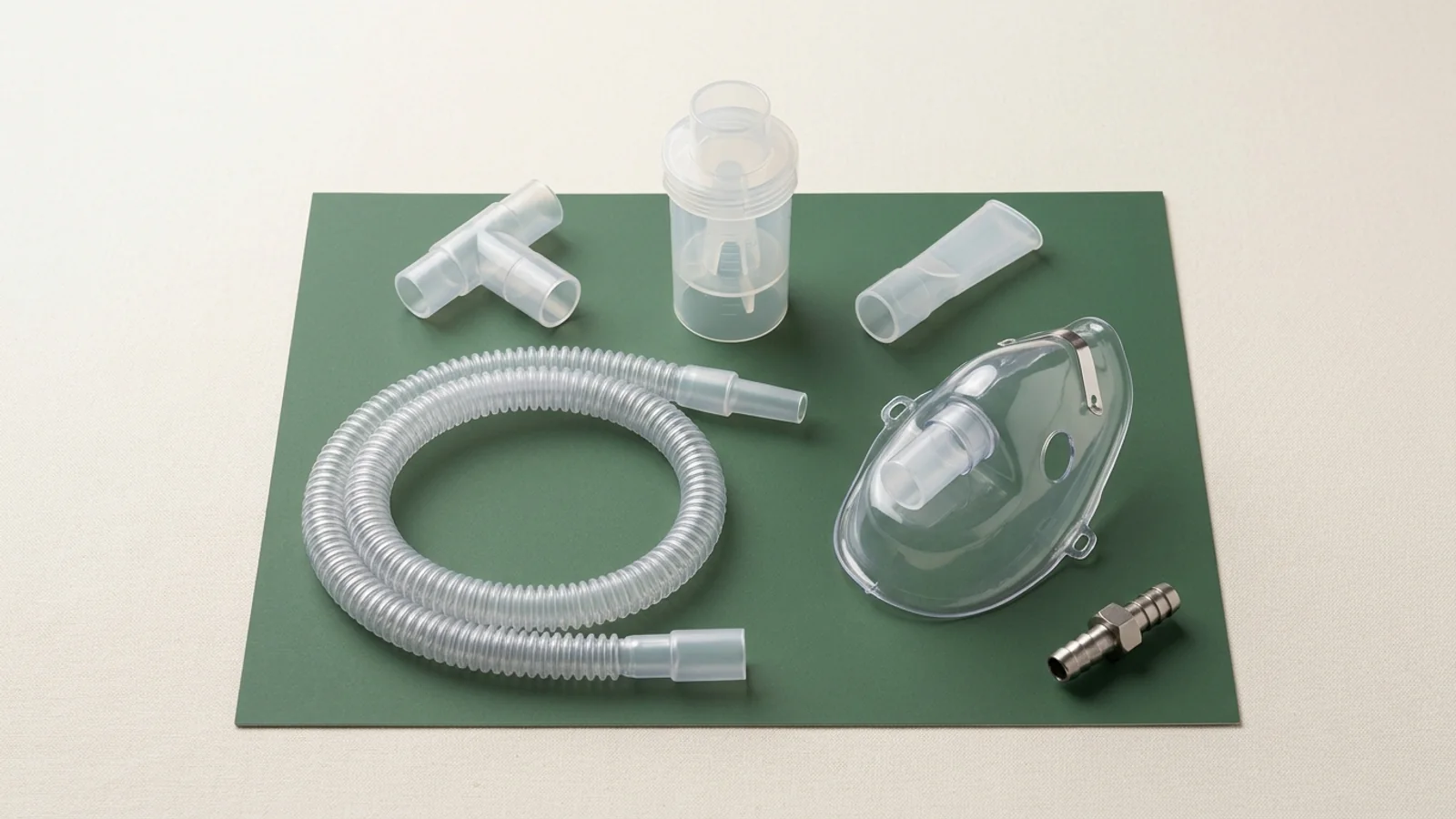
When hospital procurement committees, biomedical engineering leads, or medical supply distributors evaluate jet nebulizer kits, shortlisted supplier catalogs frequently lead with commercial talking points: an "8 mL medication cup," a photo of coiled clear PVC tubing, and a sweeping label claim of "universal compressor compatibility." Yet behind this simplified commercial packaging lies a critical regulatory and engineering reality: a retail nebulizer kit is never a single regulated medical device. It is a heterogeneous bundle of distinct Class II and Class I products manufactured to varying pneumatic tolerances, with diverse replacement intervals and disparate reimbursement codes.
In hospital tenders and outpatient distribution contracts, an incompatible kit is a sourcing failure before it is a clinical one. If the cup's labeled driving-gas flow and pressure are not met, the manufacturer has not claimed the droplet characteristics printed in that instructions for use. A separate, documented goods-receipt failure is airway occlusion: in 2011, FDA Class 2 recall Z-0108-2012 covered Salter Laboratories nebulizer kits after a small number of mask components were found with completely obstructed airways. Purchasing teams should look beyond nominal cup capacity and verify the product code and clearance, labeled driving-gas limits, reuse boundaries, ISO 27427 test conditions when performance is claimed, and the Medicare component codes before swapping a SKU.
What a 'Nebulizer Kit' Actually Contains — And Which Parts Are the Regulated Product
In commercial supply channels, a standard jet nebulizer kit SKU bundles several distinct pneumatic and patient-interface components inside an unsealed or heat-sealed polybag. Typical kit contents include:
Medication cup assembly: A graduated polymer cup (usually 6 mL to 10 mL nominal volume) fitted with an internal capillary aspirating nozzle, venturi orifice, and droplet impaction baffle.
T-piece (tee connector): A rigid tubular junction connecting the nebulizer cup discharge port to the patient interface and an aerosol reservoir tube.
Breathing mouthpiece or aerosol mask: Either an angled plastic mouthpiece (sometimes valved) for cooperative patients, or an elastomeric aerosol face mask with an elastic head strap for pediatric or dyspneic adult patients.
Aerosol reservoir flex tube: A short length (typically 5 to 6 inches) of corrugated 22 mm tubing attached to the distal limb of the T-piece to capture aerosolized mist during the expiratory phase.
Compressed gas supply tubing: Often a 7-foot (2.13 m) length of polymer tubing with molded push-on connectors. Treat length, lumen style, and connector shape as labeled fields for the SKU, not as a universal kit specification.
Specialty accessories (conditional): Certain specialized administration sets include exhalation filters (for hazardous medications such as pentamidine), one-way inspiratory valves, or compressor air intake replacement filters.
Crucially, international standards draw a strict boundary between aerosol generation and patient delivery. Under Clause 3.14 of ISO 27427:2023 ("Anaesthetic and respiratory equipment — Nebulizing systems and components"), a nebulizing system is formally defined as the collection of components, up to and including the aerosol outlet port, required to convert liquid medication into an aerosol available for inhalation. Note 1 of the definition explicitly states:
"Airway devices (e.g. masks, tracheal and tracheostomy tubes, supralaryngeal airways) and breathing systems are not part of the nebulizing system."
This distinction is not academic semantics. For a medical consumable buyer, it defines how device risk is allocated across federal classifications, which component carries premarket review data, and why an aerosol mask cannot be held to the same 510(k) clearance requirements as the nebulizer cup.
flowchart TD
    subgraph Capital ["1. Driving Gas Source (Capital Equipment)"]
        COMP["Driving gas is labeled per cup
(example: PARI LC Sprint 3.5-8 L/min, min 20 psi)
(E0565 is a different code: >30 psi at 6-8 L/min)"]
    end

    subgraph NebSystem ["2. Nebulizing System (Class II, 510(k) Cleared)"]
        CUP["Graduated Medication Cup
(21 CFR 868.5630, Product Code CAF)"]
        JET["Capillary Nozzle & Venturi Baffle
(Primary Droplet Breakdown)"]
        OUTLET["Aerosol Outlet Port
(ISO 27427 Boundary Limit)"]
        CUP --> JET --> OUTLET
    end

    subgraph Interfaces ["3. Bundled Patient Interfaces (Class I, 510(k) Exempt)"]
        TEE["22 mm T-Connector
(Flow Diverter)"]
        MOUTH["Rigid Breathing Mouthpiece
(21 CFR 868.5620, Code BYP)"]
        MASK["Aerosol Face Mask
(21 CFR 868.5580, Code BYG)"]
        RES["6-inch Corrugated Reservoir Tube"]
    end

    COMP -->|Crush-Resistant Tubing
7-foot Funnel End| CUP
    OUTLET --> TEE
    TEE --> MOUTH
    TEE --> MASK
    TEE --> RES
Regulatory Identity: 21 CFR 868.5630, Product Code CAF, and 510(k) Clearance
Under U.S. Food and Drug Administration (FDA) regulations, the functional core of the kit is classified under 21 CFR 868.5630 as a Nebulizer. The statutory regulation identifies the device as an apparatus intended to spray liquids in aerosol form into gases that are delivered directly to the patient for breathing, encompassing heated, ultrasonic, gas, venturi, and refillable systems. In the CDRH classification database, direct patient-interface nebulizers fall under Product Code CAF as Class II (performance standards) devices requiring premarket notification under Section 510(k) of the Food, Drug, and Cosmetic Act.
FDA's October 1993 reviewer guidance treats nebulizers as prescription devices that need a cleared 510(k) before marketing. Current 21 CFR 801.109(b)(1) requires the label, other than surgical instruments, to bear "Rx only," "℞ only," or the caution statement with the practitioner blank filled in. One allowed form is: "Caution: Federal law restricts this device to sale by or on the order of a physician." "Rx only" satisfies the same clause. A catalog that markets a CAF nebulizer with none of these statements, and without a registered establishment listing, is a procurement compliance flag.
When reviewing a prospective supplier's regulatory dossier, buyers should examine the exact device cleared in the underlying 510(k) summary. For example, in clearance K070948 (Hsiner Nebulizer Bottle), the cleared subject device is the standalone nebulizer cup and baffle assembly, establishing substantial equivalence based on aerosol output, particle sizing, and material safety. Similarly, in clearances for prefilled or kit-adjacent components such as Medline's K231058 (AddiPak Unit Dose Vial), the clearance summary outlines extensive biocompatibility batteries (cytotoxicity, intracutaneous reactivity, sensitization, and particulate matter) alongside shelf-life and sterility validation.
The Mask and Mouthpiece in the Box: Class I 510(k)-Exempt Patient Interfaces
While the nebulizer cup requires 510(k) clearance, the bundled patient interfaces packaged inside the same kit bag operate under distinct, lower-risk regulatory classifications:
Aerosol Face Mask (21 CFR 868.5580, Product Code BYG): Classified as an Oxygen Mask, identified as a device placed over a patient's nose, mouth, or tracheostomy to administer oxygen or aerosols. Masks are classified as Class I (General Controls) and are exempt from 510(k) premarket notification subject to the general limitations of exemption under 21 CFR 868.9.
Breathing Mouthpiece (21 CFR 868.5620, Product Code BYP): Classified as a Breathing Mouthpiece, identified as a rigid device inserted into a patient's mouth that connects with respiratory therapeutic or diagnostic devices. Mouthpieces are likewise Class I devices exempt from 510(k) clearance.
Understanding this mixed-class bundle structure prevents procurement officers from committing two common errors during supplier qualification:
First, buyers should not reject a kit simply because the vendor cannot provide an individual 510(k) number for the mask or mouthpiece. Those interfaces are Class I and 510(k)-exempt subject to 21 CFR 868.9. The manufacturer still needs establishment registration, device listing, and a quality system that meets the current 21 CFR Part 820 Quality Management System Regulation, which replaced the old Quality System Regulation name on February 2, 2026.
Second, buyers must not assume that 510(k) exemption implies zero quality risk. Receiving quality checks must rigorously evaluate interface manufacturing, such as verifying the patency of exhalation ports and the integrity of elastic strap attachments. For related insights on hospital receiving protocols and medical device tracking, review our guide on UDI and GUDID for Medical Consumables.
| Kit Component | Federal Regulation | FDA Class & Code | Premarket Review | Governing Technical Standards |
|---|---|---|---|---|
| Nebulizer Cup & Baffle Assembly | 21 CFR 868.5630 | Class II (CAF) | 510(k) Cleared | ISO 27427:2023; ISO 18562 series when gas-pathway claims are made |
| Aerosol Face Mask (Adult / Ped) | 21 CFR 868.5580 | Class I (BYG) | 510(k) Exempt (868.9) | Confirm labeled connector size and any ISO 10993 evidence the maker supplies |
| Breathing Mouthpiece | 21 CFR 868.5620 | Class I (BYP) | 510(k) Exempt (868.9) | Confirm labeled connector; do not assume an ISO 5356 claim |
| Corrugated Reservoir Tubing | 21 CFR 868.5630 accessory | Class II (CAF) / Class I | Evaluated in System | Confirm whether the tube is inside the cleared system or a separate accessory |
| 7-ft Oxygen / Gas Supply Tubing | 21 CFR 868.5630 accessory | Class II (CAF) / Class I | Evaluated in System | Record labeled length and connector type; do not assume a star lumen |
| Exhalation Filter Assembly | Confirm the filter's own listing; A7006 is the Medicare filtered-set code | Do not assign CAH or CAF without the listing | Read the 510(k) or listing for that filter | Use the labeled filtration claim only; no default efficiency applies |
Connector and Driving-Gas Compatibility: Tubing Ends, Fittings, and Operating Points
The term "universal fit" is ubiquitous on retail packaging, but pneumatic reality is tightly constrained. A jet nebulizer operates on the venturi principle: pressurized driving gas enters through a sub-millimeter nozzle, creating a localized drop in static pressure that draws liquid up internal capillary channels into the high-velocity gas stream, where droplets impact a baffle to break into aerosol. If the driving gas source cannot deliver the exact flow rate and dynamic pressure required by the nozzle geometry, atomization degrades instantly.
Consider the manufacturer Instructions for Use (IFU) for the widely deployed PARI LC Sprint Reusable Nebulizer (IFU 023D0221). The manufacturer explicitly mandates:
"The compressor or central air supply must provide 3.5 - 8 lpm at a minimum of 20 psi to achieve the specified droplet characteristics."
That sentence is a labeled condition for the PARI LC Sprint, not a universal jet-cup curve. If the connected compressor does not meet 3.5–8 L/min at a minimum of 20 psi, the IFU does not claim the droplet characteristics it specifies. Do not convert a shortfall into an assumed particle size, deposition site, or treatment duration. Record the compressor's labeled output and the cup's labeled requirement, and mark either field Unknown when the vendor does not report it.
Medicare compressor codes describe equipment classes. They are not a substitute for the cup's labeled flow and pressure:
Cup IFU, worked example: PARI LC Sprint instructions (Rev B, 04/18) require 3.5–8 L/min at a minimum of 20 psi to achieve that product's specified droplet characteristics. Do not copy those numbers onto another brand.
Small-volume compressor (HCPCS E0570): LCD L33370 pairs E0570 with small-volume nebulizers A7003, A7004, and A7005 for covered inhalation drugs. The LCD does not publish a flow or pressure that makes every cup compatible. Match the compressor label to the cup IFU.
Heavy-duty continuous compressors (CMS E0565): Policy Article A52466 describes E0565 as an aerosol compressor for pressures above 30 psi at 6–8 L/min with continuous operation. LCD L33370 allows E0565 or E0572 with a filtered nebulizer (A7006) for pentamidine. That is a coverage pairing, not proof that every filtered kit needs E0565.
Connector geometry is a labeled field. Record the tubing ends and the compressor fitting the IFU names, and do not treat "universal" as compatibility evidence. For a separate decision about oxygen-outlet adapters, see Oxygen Tubing Connectors and Adapter Sizing.
| Driving Gas Supply Type | Operating Flow Range | Typical Working Pressure | Pneumatic Match with Jet Cups | Procurement Assessment |
|---|---|---|---|---|
| PARI LC Sprint cup IFU (one reusable example) | 3.5–8 L/min | Minimum 20 psi | Required only to achieve that IFU's specified droplet characteristics | Do not copy these numbers onto other cups |
| Standard Home Compressor (CMS E0570) | Not stated in LCD L33370 | Not stated in LCD L33370 | Code pairs with A7003, A7004, and A7005; it is not a compatibility test | Compare the compressor label with the cup IFU; else Unknown |
| High-Output Compressor (CMS E0565) | 6–8 L/min | Above 30 psi, continuous (A52466 wording) | LCD allows E0565 or E0572 with A7006 for pentamidine | Coverage context only; still match the cup IFU |
| Unlabeled "universal" compressor | Unknown | Unknown | No particle-size inference without the cup IFU and test conditions | Do not accept the marketing claim as a match |
Aerosol Performance Data: ISO 27427:2023 Testing Scope and the 'No Minimum Performance' Caveat
When evaluating technical data sheets, buyers frequently encounter bold supplier statements such as "Delivers 80% of particles in the respirable range" or "Ultra-fine aerosol delivery." Without strict verification against standardized testing methods, these claims are clinically meaningless.
The current benchmark for aerosol device evaluation is ISO 27427:2023 (Fourth Edition, FR Recognition 1-194), recognized by FDA CDRH as an applicable consensus standard for 21 CFR 868.5630 and Product Code CAF. ISO 27427 establishes rigorous engineering protocols for evaluating:
Particle size distribution: Measured using multistage cascade impactors (e.g., Next Generation Impactor [NGI] or Andersen Cascade Impactor [ACI]) to determine Mass Median Aerodynamic Diameter (MMAD) and Geometric Standard Deviation (GSD).
Aerosol output rate: The mass of aerosol leaving the outlet per unit time. ISO 27427 defines the method; it does not name one drug or a pass rate. Ask for the formulation, flow, and units the report actually used.
Total aerosol output: The absolute mass of medication delivered to the cascade impactor collection cups during complete nebulization until sputtering occurs.
Residual volume: Liquid left in the cup that the test does not deliver. There is no universal residual volume. Record the figure from the IFU or test report, or mark it Unknown.
Historically, FDA's Reviewer Guidance for Nebulizers, Metered Dose Inhalers, Spacers and Actuators (October 1993) describes 510(k) expectations that include cascade-impactor particle sizing with MMAD and GSD, testing with more than one drug, spray pattern, and delivered drug amount. It does not set an MMAD or GSD pass band. Ask for the reported MMAD, GSD, test flow, formulation, and method. If the sheet gives only an unconditioned respirable-fraction percentage, record performance as Unknown.
Sterility, Reuse Limits, and Cleaning Intervals: What the Manufacturer IFU Permits
Commercial nebulizer kits exhibit wide variations in labeled operating lifespans. Hospital supply buyers must never treat the catalog term "disposable" as synonymous with single-use, nor assume that different reusable cups can follow identical hospital reprocessing protocols.
Major manufacturers structure their kits into three distinct operational categories:
Short-term disposable kits: Designed for single-patient use over a limited hospital stay or outpatient course. For instance, the Mercury Medical Pulmo-Neb kit line is explicitly catalog-labeled as a "60-day disposable nebulizer kit with mouthpiece and 7-foot tubing." Treat 60 days as that catalog's labeled interval only. The catalog line does not establish a washing method for every disposable kit.
Multi-month reusable kits: High-durability kits engineered for chronic home care or outpatient pulmonary rehabilitation. The PARI LC Sprint IFU certifies the reusable cup for six months of daily single-patient use, backed by a six-month manufacturer warranty. However, the label explicitly mandates replacing the cup every six months to prevent orifice erosion and jet degradation.
Sterile unit-dose and delivery consumables: Standard jet kits such as the PARI LC Sprint are labeled not sterile. K231058 clears Medline's AddiPak unit-dose vial, a different CAF device, and its summary reports sterile status, single use, shelf life, and a biocompatibility battery. That vial file is not a 510(k) for the jet cup.
Cleaning and thermal disinfection limits are strictly component-dependent. In the PARI LC Sprint IFU, the manufacturer permits thermal disinfection of plastic cup components via boiling (5 minutes) or autoclaving (up to 277°F / 136°C). However, the IFU issues a critical contraindication regarding the supply tubing:
"Never wash or boil the tubing. Tubing cannot be effectively cleaned or dried inside. Moisture retained in tubing promotes bacterial growth."
Procurement teams must ensure that clinical protocols align with manufacturer labeling: reusable nebulizer cups must have designated thermal disinfection pathways, while supply tubing must be treated as a replaceable consumable that is never submerged or washed internally.
Material Disclosures and Gas-Pathway Safety: Latex, PVC, DEHP, and ISO 18562 Conformity
Because nebulizer driving gas is inhaled directly into the respiratory tract, material disclosures are paramount. Catalog product sheets routinely advertise "Latex-Free" and "DEHP-Free" construction, but institutional buyers must verify the underlying conformity testing.
Under current FDA CDRH policy for Product Code CAF, recognized standards include the comprehensive ISO 18562 series ("Biocompatibility evaluation of breathing gas pathways in healthcare applications", second edition 2024-03). While general external medical devices rely on ISO 10993-1, respiratory gas pathways require specialized gas-stream analysis:
ISO 18562-2 (Particulate Matter): Tests for emissions of particulate matter into the breathing-gas pathway. FDA lists the second edition (2024-03) for product code CAF. Do not translate the standard into an ambient PM2.5 or PM10 limit the recognition record does not state.
ISO 18562-3 (Volatile Organic Compounds): Evaluates gaseous emissions of volatile organic compounds (VOCs) leaching from plasticized flexible tubing and molded polymer cups during active operation.
ISO 18562-4 (Condensate Leachables): Analyzes water-soluble and aerosol-soluble chemical compounds that leach into liquid medication pooled within the cup or condensing on the inner lumen of corrugated delivery tubes.
Hospital buyers should demand a formal Certificate of Analysis (CoA) or 510(k) summary statement confirming testing against the ISO 18562 series and ISO 10993-1 cytotoxicity, sensitization, and intracutaneous reactivity batteries. For broader principles on establishing supplier compliance files, consult our explainer on Quality Agreements for Consumable Suppliers.
Why Medicare Does Not Buy a 'Kit': The HCPCS Component Breakdown
In U.S. outpatient and home health supply contracts, healthcare systems and durable medical equipment (DME) providers face strict billing constraints. Medicare and commercial payers do not recognize or reimburse a single bundled "nebulizer kit SKU." Instead, CMS claims processing strictly unbundles the kit into separate Healthcare Common Procedure Coding System (HCPCS) codes governed by CMS DME MAC Policy Article A52466 and Local Coverage Determination (LCD) L33370.
Under CMS Policy Article A52466, nebulizer consumables are defined by exact component combinations:
HCPCS A7003: "Administration set, with small volume nonfiltered pneumatic nebulizer, disposable." Policy Article A52466 explicitly states: "HCPCS codes A7003, A7005, and A7006 include the lid, jar, baffles, tubing, T-piece and mouthpiece."
HCPCS A7004: "Small volume nonfiltered pneumatic nebulizer, disposable." The CMS policy article clarifies: "HCPCS code A7004 includes only the lid, jar and baffles."
HCPCS A7005: "Administration set, with small volume nonfiltered pneumatic nebulizer, non-disposable (reusable)." Covers reusable cups (e.g., PARI LC Sprint) with T-piece, tubing, and mouthpiece.
HCPCS A7006: "Administration set, with small volume filtered pneumatic nebulizer." Adds a dedicated exhalation filter system to prevent atmospheric aerosol contamination (mandated under LCD L33370 for pentamidine delivery).
HCPCS A7015: "Aerosol mask, used with DME nebulizer." Masks are billed separately from administration sets.
HCPCS A7008: "Prefilled disposable large volume nebulizer." Explicitly designated under CMS policy as noncovered under the DME benefit as a convenience item.
Furthermore, DME Medicare Administrative Contractors (DME MACs) such as Noridian Healthcare Solutions (Jurisdiction D) enforce rigid monthly utilization caps:
A7003 (Disposable administration set): Allowed up to 2 units per month.
A7004 (Replacement cup/jar/baffle only): Allowed up to 2 units per month in addition to A7003.
A7005 (Reusable administration set): Noridian Jurisdiction D allows one every three months only when billed with K0730. Other payers can differ.
A7015 (Aerosol mask): Allowed 1 unit per month.
A7013 (Compressor intake filter kit): Allowed up to 2 units per month.
If a hospital supply room purchases kit SKUs that permanently bundle a mask, cup, and tubing together without unbundled SKU options, outpatient pharmacies and DME distribution arms cannot bill payers properly for replacement cups without triggering claim rejections for duplicate masks. Procurement must maintain both integrated kits (for acute floor use) and separate component lines (A7004 cups and A7015 masks) for compliant billing.
| HCPCS Code | CMS Policy Component Scope | Payer Billing Classification | Standard DME Monthly Cap | Procurement & Par-Level Rule |
|---|---|---|---|---|
| A7003 | Lid, jar, baffles, tubing, T-piece, mouthpiece | Disposable small volume administration set | 2 per month | Primary kit for routine inpatient / outpatient use |
| A7004 | Lid, jar, and baffles ONLY (no tubing/mouthpiece) | Disposable nebulizer cup replacement | 2 per month (with A7003) | Must stock separately for mid-month cup changes |
| A7005 | Lid, jar, baffles, tubing, T-piece, mouthpiece | Nondisposable (reusable) administration set | 1 per 3 months | Noridian: one per three months only with K0730; other payers may differ |
| A7006 | Lid, jar, baffles, tubing, T-piece, mouthpiece + filter | Filtered administration set (hazardous drugs) | 1 per month | LCD L33370 pairs A7006 with E0565 or E0572 for pentamidine; confirm current wording |
| A7015 | Aerosol face mask with elastic head strap | Aerosol mask accessory | 1 per month | Billable separately from administration set |
| A7008 | Prefilled large volume nebulizer | Noncovered convenience item | 0 (Noncovered) | Excluded from Medicare outpatient reimbursement |
Receiving Inspection and Recall Lessons: Verifying Airflow and Tracing UDI
Physical goods receipt of nebulizer kits cannot be limited to barcode scanning and counting cartons. Historical recall events demonstrate that packaging integrity and component airway patency require direct physical verification.
In FDA Class 2 Recall Z-0108-2012 (Recall Event ID 58454), initiated March 25, 2011 and terminated October 26, 2011, Salter Laboratories recalled about 9,000 nebulizer kits (adult elastic-strap aerosol mask and 7-foot tube, product code 8924-7-50, lot 022811). FDA classified the product under CCQ, not CAF. The record states:
"A small number of oxygen mask components were found to have 100% obstructed airways rendering them incapable of delivering oxygen to patients undergoing respiration therapy."
The obstruction occurred during plastic injection molding, leaving the central airway connector completely solid. If clinical staff connected this defective mask to a patient, gas delivery was physically impossible. This incident underscores why receiving inspection plans must sample kits across every incoming lot to test physical airflow through masks, T-pieces, and tubing lumens before releasing stock to clinical storage.
Receiving QA teams must establish a rigorous 4-point acceptance checklist:
Visual airway patency: Verify clear, unobstructed lumens through mask 22 mm connector ports, T-pieces, and corrugated flex tubes.
Tubing elasticity and retention: Check that the tubing ends match the fitting named in the IFU. There is no universal barb diameter or pull-off force to apply at receiving.
Sterility and packaging seal: Check that polybags are intact with no particulate contamination, pinholes, or seal blowouts.
UDI and lot capture: Scan the Unique Device Identifier (UDI) barcode on the carton and primary pack, verifying Device Identifier (DI), Production Identifier (PI), lot number, and expiration date against the enterprise ERP system.
The Buyer's Specification Comparison Table: Fields to Demand Before Swapping a SKU
To establish a legally defensible tender line or approve an alternative supplier SKU, procurement officers should demand the following reproducible specification matrix. If a vendor cannot supply documented evidence for any parameter, log that field as UNKNOWN. Never infer clinical equivalence or pneumatic compatibility from catalog marketing copy.
| Specification Domain | Critical Labeled Field to Demand | Common Catalog Marketing Trap | Verification Document to Require | Status if Unreported |
|---|---|---|---|---|
| Device Regulatory Identity | 21 CFR 868.5630, Product Code CAF, 510(k) # | Cites Class I exempt atomizer code (CCQ) or omits 510(k) | FDA 510(k) clearance letter & CDRH listing | NON-COMPLIANT |
| Rx Device Labeling | Prescription legend per 21 CFR 801.109(b)(1) | Sold as unregulated consumer wellness product | Product packaging artwork & primary label | NON-COMPLIANT |
| Driving Gas Flow Rate | Rated flow in L/min (e.g., 3.5 – 8.0 L/min) | "Universal compressor compatibility" | Manufacturer IFU pneumatic specification | UNKNOWN |
| Driving Gas Pressure | Minimum dynamic backpressure in psi (e.g., 20 psi) | Omits working pressure; lists open-flow compressor psi | Manufacturer IFU & engineering data sheet | UNKNOWN |
| Aerosol Particle Sizing | Reported MMAD and GSD, plus test flow, formulation, and method | "80% of particles in respirable range" (unconditioned) | Cascade impactor test report per ISO 27427:2023 | UNKNOWN |
| Aerosol Output Rate | Output rate in mL/min or mg/min at specified flow | "Rapid treatment times" (no metrics cited) | ISO 27427:2023 laboratory test summary | UNKNOWN |
| Nominal Fill vs. Residual | Maximum fill volume (mL) and dead-space volume (mL) | Advertises cup capacity and omits residual volume | Cup volumetric graduation drawings & IFU | UNKNOWN |
| Operational Lifespan | Single-use, 60-day disposable, or 6-month reusable | Uses "disposable" to imply single treatment use | Manufacturer IFU labeled replacement interval | UNKNOWN |
| Thermal Cleaning Limits | Dishwasher, boiling (min), autoclave temp; NO tubing wash | "Fully washable kit" (tubing washing contraindication omitted) | Manufacturer IFU reprocessing protocol | UNKNOWN |
| Gas-Pathway Biocompatibility | Particulate, VOC, and condensate testing | Vague "latex-free, non-toxic PVC" marketing claims | ISO 18562 series & ISO 10993-1 test reports | UNKNOWN |
| Reimbursement Code Alignment | Exact HCPCS crosswalk (A7003, A7004, A7005, A7015) | Sells all-in-one kit; no unbundled cup SKU (A7004) | CMS PDAC coding verification letter | UNKNOWN |
| Product Traceability | UDI Device Identifier (DI) and Production Identifier (PI) | Unbarcoded polybag packaging with lot number only | FDA GUDID public database record and the label barcode, if UDI applies | VERIFY |
By executing this structured verification protocol, hospital buyers and distributor category managers transform nebulizer kit procurement from an unverified commodity purchase into a rigorous, clinically aligned engineering decision. For further guidance on consumable storage parameters and logistics controls, see our resource on Labeled Storage and Transport for Medical Consumables.