
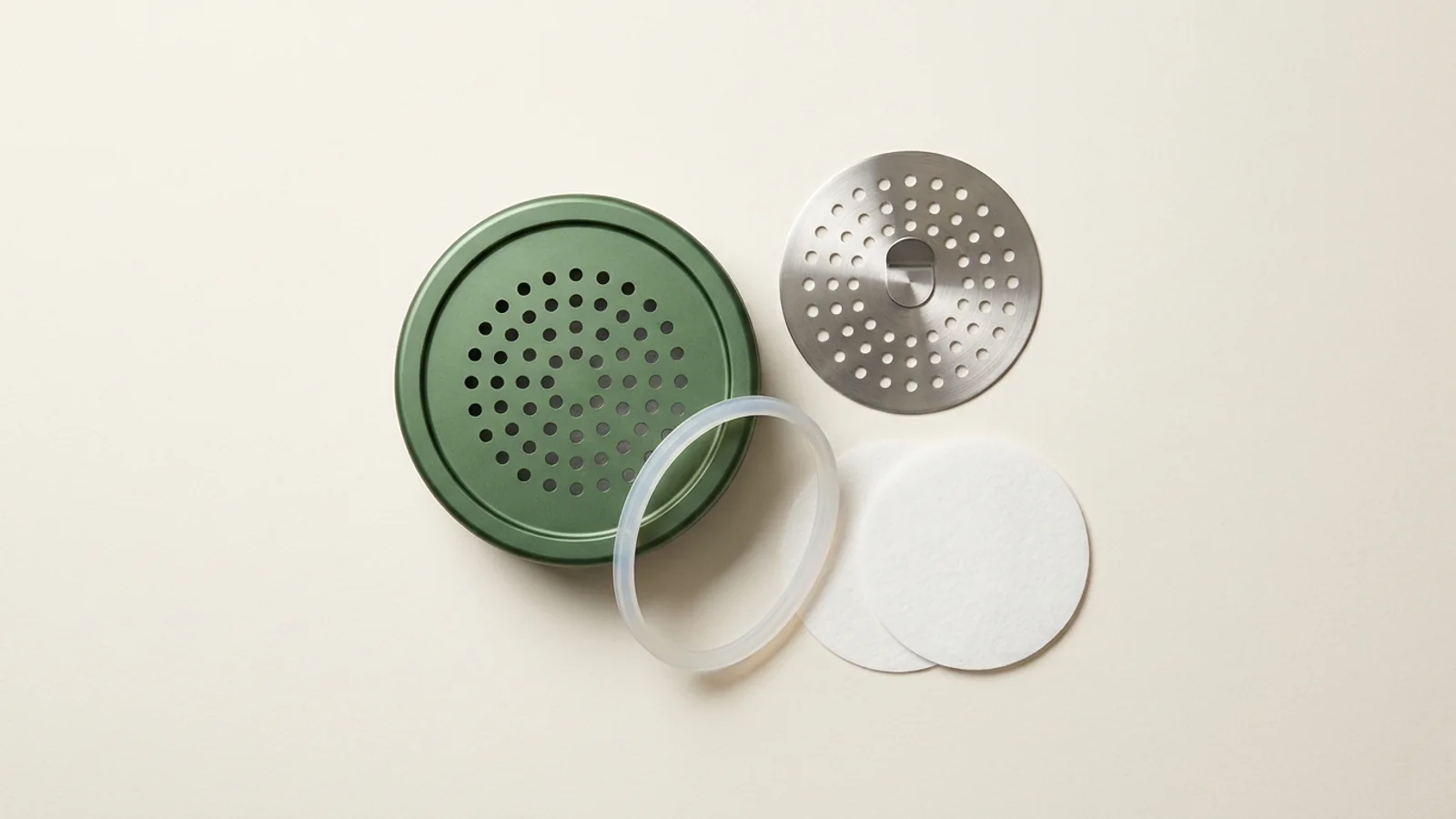
Order rigid sterilization container filters by the documented system, lid and base configuration, and sterilization method. Start with the manufacturer and model identifiers on the container, then obtain the matching instructions for use (IFU). Record the filter part number, quantity for the complete assembly, and single-use or reusable status before requesting a quote. A filter that fits the opening still needs documented compatibility.
For inherited containers with missing paperwork, keep unresolved units out of the purchasing cross-reference until the manufacturer confirms their identity. Photograph the markings and separate lid and base identifiers. Similar dimensions, colors or retention plates are clues for a manufacturer inquiry; they do not establish that parts belong together. This guide supports procurement identification, with dated examples and a receiving record. Processing decisions remain with the facility and the applicable device, container and sterilizer instructions.
Where the filter sits: lid, base and retention plate
Filters cover designated vented areas while allowing air and sterilant to pass. The barrier depends on the filter and its retention mechanism within the complete container. Aesculap describes a retention plate that secures its SterilContainer filter with an audible click. That feature describes the named system; it is not a universal identification test. Aesculap system overview.
Distinguish three things in the inventory record: the lid, the base, and the filter assembly. A perforated base can add filter positions beyond those in the lid. A solid base does not establish which lid was supplied, which filter material is eligible, or which sterilizer cycle the system supports. Record each component before calculating consumable demand.
Identify the manufacturer, model and generation from markings and supplier records. Send photographs to the manufacturer when an identifier is incomplete or unreadable.
Find the model-specific IFU and record its revision. Confirm that the lid and base combination is covered, including any replacement lid fitted during the container’s service life.
Record the specified filter locations and retention hardware. Separate a filter disc, a retention plate and a cleaning rack into different item records.
Copy the eligible filter part numbers and material from the labeling for the intended sterilizer and method. Request written clarification where documents disagree.
Calculate the complete container’s filter quantity, then identify the pack quantity used for ordering. Preserve any unresolved field explicitly rather than estimating it from a similar unit.
Regulatory records help establish identity
FDA lists sterilization containers, trays, cassettes and related accessories under product code KCT, Class II, regulation 21 CFR 880.6850, with 510(k) submission type. The classification page also lists recognized standards ANSI/AAMI ST77:2013/(R)2018 and ISO 17665:2024. Recognition identifies a regulatory reference; the listing does not establish compatibility between a particular container and replacement filter. FDA KCT classification.
These FDA clearance records provide useful names and dates for supplier-file checks:
Aesculap Aicon Series Container System: K242762, decision May 13, 2025. FDA record
Case Medical SteriTite Reusable Rigid Sterilization Container System with MediTray accessories: K173259, decision June 13, 2018. FDA record
SteriTite Container System with MediTray Products: K252854, decision June 3, 2026. FDA record
Each record reports a substantially equivalent decision. Use the device name and applicant to check the supplier’s account of the system. A clearance number alone does not tell a buyer how many filters a particular lid needs, whether a replacement lid fits an older base, or whether a third-party consumable has been validated for that combination. Request the supporting labeling and compatibility evidence for those questions.
For European specifications, the published scope of EN 868-8:2018 concerns reusable containers used as sterile barrier systems in steam sterilizers conforming to EN 285. Its scope notes user validation of performance for a specific cycle when a steam sterilizer does not conform to EN 285. It is not a blanket statement of low-temperature compatibility or legal adoption. EN 868-8 scope.
Named-system filter counts and reuse identity
The table separates confirmed catalog quantities from fields requiring the installed model’s IFU. Aesculap examples refer to DOC132 Rev H, dated November 13, 2023, not every later container generation. Use this dated reference to check an inventory record, then confirm the current instructions for the actual model before ordering.
| System and configuration | Filter quantity / position | Material or part identity | Use status | Evidence |
|---|---|---|---|---|
| SterilContainer, full-size aluminum lid, solid base | 2 round filters total; lid | Paper US751 / US994 | Disposable selection | DOC132 Rev H, pp. 20, 35 |
| SterilContainer, full-size aluminum lid, perforated base | 4 round filters total; lid and base | Paper US751 / US994 | Disposable selection | DOC132 Rev H, pp. 20, 35 |
| SterilContainer, half- or three-quarter-size aluminum lid | Solid base: 1; perforated base: 2 total | Paper US751 / US994 | Disposable selection | DOC132 Rev H, pp. 22, 24, 35 |
| SterilContainer, PrimeLine Pro lid | Reusable lid assembly; assess base separately | PTFE JP050 | Reusable; follow system IFU | DOC132 Rev H, pp. 20, 35 |
| Aicon full-size catalog example | 1 filter per set; confirm installed model | Obtain Aicon-specific SKU | Confirm model IFU | DOC132 Rev H, p. 7 |
| SteriTite disposable-filter configuration | Solid base: lid; perforated base: lid and base; total model-specific | Cellulose SCF01 round / SCFM01 rectangular | Single-use | SteriTite IFU Rev. 10, p. 9; cellulose flyer Rev C |
| Genesis: Case Medical filter offering | Complete-container count not established here | 9 × 9-inch polypropylene SCF9S02 | Single-use | Square-filter flyer Rev C, December 2023 |
Table sources: Aesculap DOC132 Rev H; Case Medical’s technical library, including its linked SteriTite IFU and filter flyers. The paper-filter counts apply to the specified aluminum-lid arrangements. Do not apply them to a reusable lid option or Aicon. The reusable lid entry does not describe every barrier component in a complete container.
Case Medical’s library also provides a KARL STORZ container IFU, identified as KSZ-IFU Rev. 10 in the document itself. It identifies Case Medical as the manufacturer and includes KARL STORZ part-number tables. Use that document to establish an OEM relationship for a specific labeled model. It does not justify treating every instrument-maker-branded container as interchangeable with every SteriTite configuration.
For a mixed fleet, retain separate rows for systems whose exact totals remain unresolved. For example, a SteriTite record can identify the filter locations and eligible material while the manufacturer confirms the total for the particular size. A purchasing record with that open question is more useful than a guessed quantity that becomes a recurring order.
Match filter material to the documented sterilization method
Case Medical describes SteriTite as a platform with broad modality compatibility, but distinguishes perforated bases from solid bases: the latter are offered for pre-vacuum steam and certain low-temperature systems. Treat the exact base and filter combination as the purchasing unit. A platform’s broad marketing claim does not make each consumable eligible for every process. SteriTite product overview.
The linked SteriTite IFU Rev. 10, dated January 1, 2025, excludes cellulosic filters from gas plasma and vaporized hydrogen peroxide sterilization. Its assembly section identifies nonwoven polypropylene filters for its hydrogen peroxide applications. The cellulose flyer also warns against using SCF01 and SCFM01 for hydrogen peroxide processing. These are product-specific restrictions, not permission to buy any polypropylene sheet of the same size.
Reusable status needs its own field. A reusable container may use disposable filters; a reusable PTFE filter option requires its particular retention assembly and instructions. Do not infer a cleaning method, service life or low-temperature claim from the polymer name. Ask the supplier for the applicable inspection, replacement and tracking requirements, and retain that response with the model record.
Substitution and stockout decisions
A 2015 Infection Control Today Q&A by Nancy Chobin describes improvised filters made from packaging material. It advises using the container manufacturer’s filter, accepting another vendor only where that vendor has validated compatibility, and never reusing single-use material. It also describes manufacturer backup stock, borrowing within the exact system, and an inner-basket wrapping alternative. This is historical professional guidance referencing 2013 standards, not a quotation from a current standard or a processing protocol. Chobin’s filter-stockout guidance.
For purchasing review, request evidence that identifies the proposed filter, the exact container and retention arrangement, and the intended sterilization method. Have the facility’s responsible technical team review that evidence alongside the current instructions. A catalog cross-reference or a statement that the dimensions match leaves those questions unanswered. No substitute is authorized by this article, and no independent 510(k) for every replacement filter is assumed.
During a stockout, first establish whether the manufacturer or another facility can supply the already documented item. Keep the borrowed product’s label and lot identity with the receiving record. If an alternative packaging method is proposed, refer it to the facility’s sterile-processing team under its approved procedures; a buyer should not turn a shortage into an improvised filter or wrapping instruction. Flexible barriers are discussed separately in our self-seal and heat-seal pouch guide and pouch usable-space guide. Those guides do not establish a rigid-container filter pairing.
What to record on the order and at goods receipt
Use the following fields as a proposed purchasing and receiving template. They are practical controls for reconciling a quote to the documented system, not a claim that every field is a statutory requirement. Keep the supplier’s answer next to its evidence so the next buyer can distinguish a confirmed specification from an unresolved request.
System identity: manufacturer, platform, model, generation, and separate lid and base identifiers. Include photographs where the description alone could refer to several variants.
Configuration and quantity: filter positions, total filters for one complete assembly, and pack quantity. Show the calculation used for expected consumption without mixing filters per container with filters per box.
Consumable identity: exact order code, material, dimensions as labeled, and disposable or reusable status. Keep similar-looking filters in separate records until the documented pairing supports consolidation.
Processing eligibility: the named sterilizer and method supported by the applicable labeling, plus the document revision used for that decision. Leave an unresolved compatibility question visible for technical review.
Hardware identity: the specified retention plate or assembly and its own part number. Distinguish replacement barrier hardware from racks used to organize parts during cleaning.
Receiving traceability: supplier, purchase order, delivered part number, pack quantity, lot or batch where provided, and condition of the delivered packaging. Compare the delivered label with the approved item record before merging stock.
Change control: record who reviewed the pairing and when. Route a changed SKU, material, lid, base or IFU through the responsible team before updating an established purchasing cross-reference.
One specific ordering trap is SCBRET01: Case Medical’s retention-plate rack flyer identifies it as a rack that holds plates during cleaning. It is not the replacement filter retention plate. The same flyer distinguishes round and rectangular plate order codes. Ask for the exact component description when a quotation uses only “filter rack” or “retention assembly.”
For label-capture methods, consult our UDI and GUDID receiving guide. For supplier changes and visible delivery damage, use the separate guides to quality agreements and recording sterile-pouch damage at goods receipt for their respective recordkeeping questions. Accessory fit inside a container is a further check, covered in our instrument tip protector guide. None of those records replaces confirmation of the lid, base and filter combination.
Close the purchasing review when the supplier evidence supports one identifiable combination: the container and its components, the eligible filter SKU, the complete quantity, and the applicable reuse rule. If one of those remains uncertain, keep the item pending technical clarification instead of creating a generic filter substitute.