
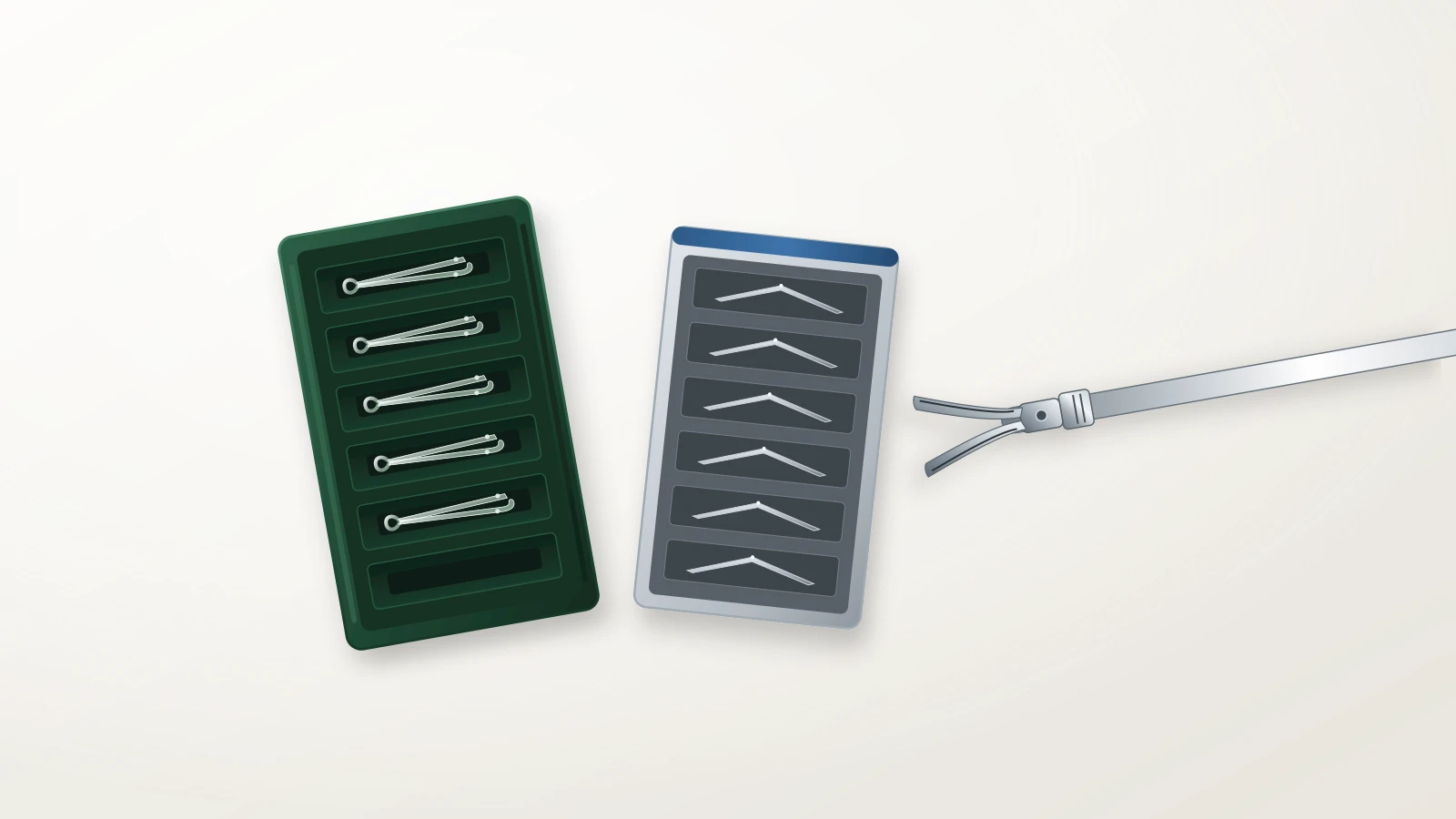
The Direct Answer: Buy the Clip, the Applier and the Cartridge as One System
When an operating room or sterile-processing department restocks ligation clips, it is tempting to treat cartridges as interchangeable as long as the clip size looks right. The manufacturer documents reviewed for this guide do not support that. They describe the clip, the cartridge, the applier, the remover and, for some single-clip systems, a cartridge base as parts of one system. The safe purchasing assumption is that a cartridge fits only the appliers its own manufacturer names for it.
In the United States the implantable clip falls under 21 CFR 878.4300 (product code FZP): Class II, cleared through 510(k), and flagged by FDA's classification record as an implanted device. The clip applier is named in 21 CFR 878.4800 (product code GDO), the Class I regulation for manual surgical instruments, and is exempt from premarket notification subject to the limitations in 21 CFR 878.9. Neither regulation sets a dimensional or cross-brand compatibility requirement, so the usable pairing evidence is each manufacturer's current labeling, instructions for use (IFU) and ordering documents.
Four checks before a restock order or an alternate bid cover most of the risk. Match every clip or cartridge REF to the exact applier codes in the manufacturer's current ordering document. Copy the current contraindication and compatibility text into the item master. Confirm that each REF is offered in your market. Check the applier's device record in FDA's Global Unique Device Identification Database (GUDID). Until a pairing appears in the clip manufacturer's own document, treat any third-party claim of universal fit as unverified.
Two FDA Classes in One Tray: Class II Implantable Clip, 510(k)-Exempt Applier
Regulatory status does not settle compatibility because the Food and Drug Administration (FDA) classifies the clip and the instrument that closes it separately. A ligation set therefore combines devices from two classifications that only work as a pair.
Implantable clip (21 CFR 878.4300, product code FZP): The regulation identifies an implantable clip as a clip-like device intended to connect internal tissues to aid healing and states that it is not absorbable. It is Class II. FDA's FZP classification record lists 510(k) as the submission type and marks the device as implanted and not exempt from good manufacturing practice (GMP) requirements.
Clip applier (21 CFR 878.4800, product code GDO): The regulation covers nonpowered, hand-held or hand-manipulated surgical instruments for general use, reusable or disposable, and its identification list names the clip applier alongside items such as the clamp, forceps, hemostat and scalpel handle. The device is Class I (general controls) and exempt from the premarket notification procedures in subpart E of part 807, subject to the limitations in 21 CFR 878.9. FDA's GDO record shows the exemption does not extend to GMP requirements.
The practical consequence is that a GDO applier generally reaches the US market without a 510(k), so there is no FDA premarket file showing that a given applier closes another company's clips. Neither regulation defines clip geometry or applier jaw fit across vendors. Classification tells a buyer what a device is; it does not say whether Brand A's applier can close Brand B's clip.
System clearances show the same logic from the other side. K254231, found substantially equivalent on July 20, 2026, covers Taiwan Surgical Corporation's Inno-Hook Disposable Clip Appliers (Ligating Clips) and Inno-Hook Ligating Clips in one submission, with FZP as the classification product code and GDO as a subsequent product code. That clearance concerns one applicant's own clips and appliers and says nothing about other brands. Apply the evidence standard used for hemostatic gauze dressings and scalpel blade fitment: the manufacturer's label decides, not the claim in a bid.
Manufacturer-Stated Pairing Record: Clips, Cartridges, Appliers and Bases
The table consolidates what four manufacturers publish about their own systems in the documents cited in this guide. It records manufacturer statements, not independent fit testing, and covers only the systems shown. Ethicon's codes come from a 2021 portfolio brochure (066249-210331) and Grena's from IFU revision IFU-U045-ENG-04 (2022), so recheck both against current ordering documents before printing codes on a purchase order.
| System | Clips and sizes | Codes and packaging | Applier lines the manufacturer names | Accessories | Pairing statement and market notes |
|---|---|---|---|---|---|
| Teleflex Weck Hem-o-lok (polymer) | Nonabsorbable locking polymer clips in Medium, Medium-Large, Large and Extra-Large; the size range is indicated for structures from 2 mm to 16 mm | REF 544220 (M), 544230 (ML), 544240 (L), 544250 (XL); 6 clips per cartridge, 14 cartridges per box | Open manual appliers (8 in and 11 in on the US page, 20 cm and 28 cm on the EMEA page; curved or right-angle jaws); manual-load endoscopic appliers, 32 cm or 45 cm, ML on a 5 mm platform (US page lists ML, L and XL; EMEA page also lists M); Auto Endo5 automatic applier AE05ML preloaded with 15 ML clips | Hem-o-lok open and endoscopic removers for polymer clips; manual applier sterilization/storage tray 544500 | Weck 360: Hem-o-lok Plus clips contraindicated with any other ligation system; Hem-o-lok Plus endoscopic appliers and removers contraindicated with any other polymer clips (the statement names the Plus generation; check the IFU for other generations). Teleflex: not all products may be available in all markets |
| Teleflex Weck Horizon and Hemoclip (metal) | Horizon titanium clips; Hemoclip traditional tantalum clips | Sizes and counts are not shown in the catalog listing cited here; take them from the current IFU and ordering sheet | Horizon endoscopic and open/manual appliers for metal clips; Hemoclip traditional appliers for metal clips | Hemoclip ligation clip cartridge base; one remover line for all Teleflex metal clips | The catalog lists metal-clip appliers separately from Hem-o-lok polymer-clip appliers; confirm the applier code for each clip in the current IFU |
| Ethicon LIGACLIP Extra (J&J MedTech) | Metal ligating clips with lateral and transverse grooves; Small, Medium, Medium/Large, Large | LT100 and LT102 (Small); LT200 and LT202 (Medium); LT300 (Medium/Large); LT400 (Large); 6 or 20 clips per cartridge | Open single-clip appliers LX105, LX107, LX110, LX130 (Small); LX205, LX207, LX210, LX220, LX230 (Medium); LX307, LX310, LX320 (Medium/Large); LX407, LX410, LX420, LX430 (Large). Endoscopic single-clip appliers EL214 (Medium), EL314 (Medium/Large), EL414 (Large) | LC800 cartridge base | J&J MedTech states the clips are compatible with both open and endoscopic single clip appliers; the 2021 brochure lists Small cartridges against open appliers only |
| Grena Click'aV and Click'aV Plus (polymer) | L for structures of 5 to 13 mm and XL for 7 to 16 mm, per the applier IFU's compatibility table | Cartridge counts are not stated in the applier IFU; take them from the clip IFU and ordering sheet | Universal Click'aV applier 0301-04LXLUNE: reusable, endoscopic, with an L/XL clip-size switch; requires a 10 mm access port | Specially designed Click'aV clip remover | Compatible with Click'aV and Click'aV Plus clips only; not compatible with LigaV or Vclip clips. Warranty does not apply to malfunctions caused by non-Grena clips |
| Aesculap (B. Braun) | Challenger Ti-P multifire system; DS Ligation Clip System with a double-clip design and an extra-large clip; traditional single-fire clips with a chevron shape | Challenger Ti-P single-use clip cartridges in Small-Medium and Medium-Large | Challenger Ti-P pneumatically powered, reusable, modular multifire applier; traditional single-fire appliers for open or laparoscopic surgery | Single-fire line uses a color-coded system to identify clip size | The product page refers buyers to the Aesculap IFU site for complete indications and contraindications; take pairing codes from the IFU and ordering documents |
Even inside one portfolio, appliers are organized by clip material. Teleflex's US catalog lists Hem-o-lok endoscopic and open appliers for polymer clips separately from Horizon appliers for metal clips and Hemoclip traditional appliers for metal clips. It splits removers the same way: one line for all Teleflex metal clips, and Hem-o-lok open and endoscopic removers for polymer clips. Build the item master to match, with one record per clip REF linked to the applier, remover and base codes that the manufacturer names for it.
Contraindication Fields to File With the SKU Record
Contraindication text belongs in the procurement record, not only in the package insert. It is the part of the label most likely to change between revisions, and the item record is where a buyer will notice the change.
For Weck Hem-o-lok polymer ligating clips, Teleflex's current US and EMEA product pages carry two contraindication statements:
Tubal occlusion: "Hem-o-lok Ligating Clips are not intended for use as a fallopian contraceptive tubal occlusion device." Teleflex's Weck 360 site words this as a contraindication for Weck ligating clips.
Laparoscopic donor nephrectomy: "Hem-o-lok Ligating Clips are contraindicated for use in ligating the renal artery during laparoscopic donor nephrectomies."
Grena's IFU for the universal Click'aV applier (IFU-U045-ENG-04) lists three contraindications: do not use for tubal ligation as a contraceptive method; do not use for renal artery ligation during laparoscopic live donor nephrectomy; and do not use to apply clips as a tissue marker. Weck 360 adds the system-level contraindications for Hem-o-lok Plus quoted above. Capture these as dedicated fields in the item record, next to the clip size, the manufacturer's stated structure-size range and the IFU revision number, so a revision change is visible at reorder.
What a Box Actually Contains: Cartridge Counts, Color Codes and Preloaded Devices
Unit-of-measure errors are common with ligation clips. A requisition for "one box of clips" can mean very different clip counts depending on the system and catalog series.
Ligation clip inventory falls into two architectures:
Cartridge-loaded reusable systems: Clips come in sterile cartridges that are loaded into a reusable applier, which sterile processing cleans and sterilizes between uses. Teleflex lists Weck Hem-o-lok clips at 6 clips per cartridge and 14 cartridges per box, or 84 clips per box; the 2006 recall record describes the same 6-by-14 configuration with 12 sales units per case. Ethicon's 2021 brochure lists LIGACLIP Extra cartridges of 6 clips (LT100, LT200, LT300, LT400) or 20 clips (LT102, LT202), packed 36, 18 or 15 cartridges per box depending on the code. Grena's IFU adds a counting rule: dispose of all opened clip cartridges whether or not all clips were used, so par levels should be set in cartridges rather than individual clips.
Preloaded multi-fire disposable devices: The applier and its clip supply are one sterile, single-use device with a fixed clip count. Ethicon's 2021 brochure lists LIGAMAX 5 (EL5ML: 5 mm, 15 Medium/Large clips, 3 per box), the ER320 and ER420 rotating endoscopic appliers (20 titanium clips each, 3 per box) and the open multiple clip appliers MCS20, MCM20, MCM30, MSM20 and MCL20 (20 or 30 titanium clips, 6 per box). Teleflex's Auto Endo5 (AE05ML) delivers 15 Medium/Large Hem-o-lok clips on a 35 cm shaft, 3 appliers per box. These devices turn the cartridge-plus-reusable-applier decision into a per-procedure disposable purchase.
The table sets out the manufacturer-stated sizes, dimensions and packaging units that receiving teams need for item masters and reorder points. "Not stated" means the cited document gives no color.
| System and code | Size | Manufacturer-stated dimension | Color reference | Packaging unit |
|---|---|---|---|---|
| Teleflex Hem-o-lok 544220, 544230, 544240, 544250 | M, ML, L, XL | Family indicated for structures from 2 mm to 16 mm; per-size ranges are in the IFU | Not stated on the cited pages | 6 clips per cartridge; 14 cartridges per box (84 clips) |
| Teleflex Auto Endo5 AE05ML | ML | 35 cm shaft | Not stated on the cited pages | 15 preloaded clips; 3 appliers per box |
| Ethicon LT100 / LT102 | Small | Clip aperture 3 mm; closed clip length 3.63 mm | Blue applier handle | LT100: 6 clips, 36 per box. LT102: 20 clips, 15 per box |
| Ethicon LT200 / LT202 | Medium | Clip aperture 4 mm; closed clip length 5.33 mm | Silver applier handle | LT200: 6 clips, 36 per box. LT202: 20 clips, 15 per box |
| Ethicon LT300 | Medium/Large | Clip aperture 6.4 mm; closed clip length 8.99 mm | Green applier handle | 6 clips per cartridge; 18 per box |
| Ethicon LT400 | Large | Clip aperture 7.5 mm; closed clip length 12.26 mm | Yellow applier handle | 6 clips per cartridge; 18 per box |
| Ethicon LIGAMAX 5 EL5ML | Medium/Large | 5 mm diameter; clip aperture 3.6 mm; closed clip length 8.8 mm | Not stated | 15 preloaded clips; 3 per box |
| Ethicon ER320 / ER420 | Medium/Large / Large | 10 mm / 12 mm diameter; clip aperture 4.2 mm / 5.2 mm; closed clip length 8.8 mm / 11 mm | Not stated | 20 preloaded clips; 3 per box |
| Grena Click'aV and Click'aV Plus L | L | Structures of 5 to 13 mm (stated for general information only) | Not stated in the applier IFU | See clip IFU and ordering sheet |
| Grena Click'aV and Click'aV Plus XL | XL | Structures of 7 to 16 mm (stated for general information only) | Not stated in the applier IFU | See clip IFU and ordering sheet |
Two cautions follow. First, color is a within-brand aid. Ethicon's brochure ties blue, silver, green and yellow to the applier handle for each clip size; Aesculap says its single-fire line is color-coded without publishing the scheme on the cited page; and the Teleflex and Grena documents cited here state no color scheme at all. Color is never a cross-brand matching key. Second, size names do not translate across brands: Hem-o-lok runs from M to XL, LIGACLIP Extra from Small to Large, Click'aV uses L and XL, and Aesculap's Challenger cartridges are Small-Medium and Medium-Large. Grena also notes that its structure-size ranges are given for general information only. Match on REF codes, not on size names, colors or ranges.
Reusable Appliers: Warranty, Repair and Reprocessing Ride on Paired Clips
Purchasing reviews tend to focus on the price per cartridge. For reusable appliers, warranty and repair terms matter as much, and the manufacturers reviewed here tie those terms to use with their own clips.
The reason is a designed interface between clip and jaw. Teleflex describes bosses on the Hem-o-lok clip that are designed to retain the clip in the applier jaws, and Grena's IFU says the clip bosses should seat in the notches of the applier jaws. J&J MedTech describes grooves on the inside jaw surfaces of its multi-patient single clip appliers that are intended to increase in-jaw clip security. Grena also tells users not to use damaged appliers and to check before use that the closed jaw tips are directly aligned and not offset. Tip alignment is also what Teleflex's endoscopic applier repair service covers.
Reprocessing instructions are system-specific too. Grena's IFU gives validated cleaning and steam sterilization parameters for its applier, including a flushing channel that needs special attention, and Teleflex's Weck 360 site says all Weck appliers and removers should be cleaned and sterilized per the instructions in their IFUs. Sterile processing needs the IFU for every applier code in the fleet, and the item record should point to it.
The commercial logic is plain. Savings from an unvalidated third-party cartridge can be lost if the cartridge voids repair terms on the facility's applier fleet. Value analysis committees should put applier warranty and repair conditions into the total cost of ownership for every ligation contract and record which clip lines those conditions name.
Before the Purchase Order: Verification Checks Buyers Can Run Today
Procurement, value analysis and sterile processing can complete four checks before a purchase order is released.
Current IFU and pairing document: Do not rely on distributor sales sheets or third-party cross-reference charts. Get the current IFU and ordering document from the manufacturer. Teleflex's Weck 360 site links its applier IFUs and the Hem-o-lok Plus IFU through the Teleflex eIFU portal and states that its educational material is not a substitute for the IFU. The Grena IFU and Ethicon brochure used in this guide are dated documents from 2022 and 2021. Confirm in writing that each clip REF on the requisition is listed against the applier codes the facility owns.
Applier records in GUDID via openFDA: openFDA's device UDI endpoint serves GUDID records. A full-text search for "Hem-o-lok" returned 100 records when checked in October 2026. The first two were WECK-branded Teleflex appliers under product code GDO (21 CFR 878.4800, Class I): catalog 544114, a Medium 11-inch 70-degree angled applier, and catalog 544181R, a Large 11-inch curved applier described as refurbished. Both are listed as prescription devices, not single-use, supplied non-sterile and requiring moist heat or steam sterilization before use. Two practical points follow. A text search returns any record that mentions the name, so filter by company, catalog number and product code before treating a hit as your device. Refurbished appliers can also carry their own catalog numbers, so receiving should check the suffix as well as the base REF. Record counts are identity data, not demand or market share.
Market availability: Teleflex's pages state that not all products may be available in all markets, and its US and EMEA pages list different open-applier lengths and endoscopic size coverage. J&J MedTech's product page says its information is intended for the United States only. Confirm that each REF is offered and registered where you buy rather than assuming one region's catalog applies elsewhere.
Compatibility in the supplier quality agreement: If a distributor or third-party supplier says its cartridges fit an installed base of Weck or Ethicon appliers, ask for the clip manufacturer's own written pairing statement and any fit testing the supplier relies on. Agree in the supplier quality agreement how applier repair costs will be handled if the claim fails, and record the source document for each pairing in the supplier file.
Filed this way, each clip and applier record can be traced from the requisition through UDI receiving workflows to the instrument tray.
What the Evidence Does Not Support: Bench Claims and Reported Complications
Value analysis committees will see marketing claims about clip retention, leak resistance and in-jaw security. Read the footnotes before giving them weight.
Teleflex's US and EMEA pages state that, in an ex-vivo study, Hem-o-lok Medium/Large clips showed at least 5 times greater lateral pull-off retention, at least 1.8 times greater leak resistance and at least 1.3 times greater axial pull-off retention than Ethicon LIGAMAX 5, Ethicon LIGACLIP ERCA 10 mm and Covidien Endo Clip III. The footnote identifies a 2013 internal study (Report D001591) on porcine carotids with a sample size of 33. It says clinical performance cannot be extrapolated from the data and that testing pressures range beyond physiological pressures. Ethicon's 2021 brochure footnotes its comparisons to benchtop testing against Covidien devices, including tests on elastomeric tubing and an elastomeric vessel model. These are bench results reported by manufacturers, not clinical comparisons, and they do not establish that one system is safer than another.
Peer-reviewed literature points the same way. Qu and colleagues (Case Reports in Surgery, 2017) describe Hem-o-lok clip migration into the common bile duct a year after laparoscopic biliary surgery. They call clip migration a rare but well-established complication whose mechanism and incidence are poorly understood. Their list of possible contributors includes inappropriate clip application (incomplete closure or incorrect placement), the number of clips used, bile leakage, pressure from organ movement and the body's response to the clip. A single case report shows that such events occur. It says nothing about how often they occur or how brands compare.
Reported events can happen without a device defect, as the 2006 Hem-o-lok recall record shows, and procurement discipline is no substitute for surgical training or technique. What it can do is make sure every clip delivered is one the manufacturer pairs with the applier in the tray, under the current label. Clip choice, sizing and technique remain decisions for qualified surgical staff.